
The Prism Perspective: Fascia for the Nerds 🤓⚡
Amy Bonaduce-Gardner | JUL 31, 2026
Hello Friends.
Found this gem in some old files the other day. I wrote it in 2017 when I still worked for Transformations Studio. Never published. This is for the nerds, an excessively long homage to back when I understood stuff and things but no idea how to tell you about it...
Many Transformations (now referred to as Fajardo Method) clients are introduced to fascia by comparing it to the slimy stuff on a raw chicken breast. We talk about how fascia slides and how it’s the source of all the achy stuff during a shift. But what does all that really mean?
Fascia is defined by Wikipedia as ”a band or sheet of connective, primarily collagen, beneath the skin that attaches, stabilizes, encloses, and separates muscles and other internal organs.” For a substance to be considered fascia, it must contain collagen, elastin, proteoglycans and glycoproteins. These four substances are found in an intercellular matrix made of fiber and ground substance, and allows fascia to have elasticity, viscosity, plasticity and strength. Fascia can be classified by its layer, function or location. Connective tissue (superficial, deep and visceral) and cartilaginous tissue (hyaline cartilage, elastic cartilage, fibrocartilage, and bone) are considered subcategories of fascia. Fascia makes up 20.6% of the human body.
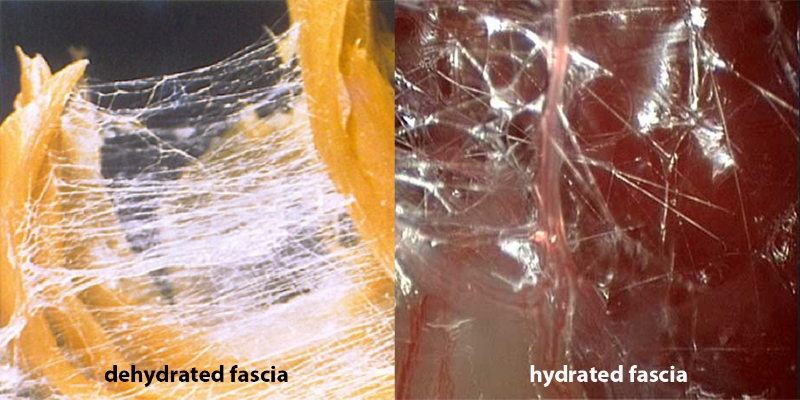
When in a sympathetic state, fascia becomes "dehydrated", more viscous, rigid, dense, compressed, and immobile. Tissue within the fascia also becomes less hydrated and less fuel reaches its cells. This allows the muscles to hold a certain shape and level of tension, joints to close and thus increase surface area available to produce friction and force, and decrease sensory input to the brain. Fascial trains may reverse the direction they slide, shift towards one side of the body, or compress from top to bottom towards the center of body and/or narrow side to side.


When in a parasympathetic state, fascia has a liquid gel-like quality, is generally warmer, more adaptable, helps maintain space in joints, efficiently distributes movement throughout the body, and increases neural transmission speed.
Fascia has many purposes:
makes up the contours of the body
acts as a glue to hold shape and form
is the casing around a bone that muscle attaches to
it wraps around muscle fibers, groups of muscle fibers and entire muscle groups
acts as a communication network for vibrations, changes in muscle contraction and position
provides a liquid transport system for hormones
provides a barrier for bacteria which supports immune system functioning
exchange medium for nutrition and waste removal
lymphatic return
circulation
acts as packing material for protection
support of posture through the horizontal bands and the Valve System
shock absorption
Tensegrity
Tensegrity is tension plus integrity. Fascia utilizes the principles of tensegrity and is an example of a biotensegrity (biology plus tensegrity) structure. It is a tension network: a blend of continuous tension (connective tissue) and compressed parts (bone). The continuous “tension” is from the intrinsic tension in the fascia itself as well as from variable tension in muscle that is attached to the fascial network. The compressed parts float in the continuous tension.
Tensegrity structures are organized in a triangulated shape, which allows it to have flexible joints, stability and adaptability. Force is distributed throughout the network (as opposed to locally). Movement in a tensegrity structure is expansion, repositioning, and contraction rather than bending of hinges.

“Anatomy Trains” by Thomas W. Myers utilizes the idea of a “double bag” to describe the embryology and function of fascia. An inner bag of fascia contains bones, cartilage and synovial fluid, while the outer bag of fascia contains muscles.
Muscles float in the outer bag and attach to the inner bag at intervals we refer to as attachments or insertions. During embryological development, a “grain” is developed in the fibers of the muscle and fascia. The grain in turn creates lines of pull in the fascia and are referred to as trains. Where the outer bag tacks down to the inner bag are stations. Communication and movement is transmitted from station to station via the outer bag.
Structure is thus the result of fascia organizing connective tissue, muscle and bone. Bones are the spacers, connective tissue is the supporting structure, and muscles provide source, direction and the actual execution of movement. “The Endless Web” (R. Louis Schultz, PhD and Rosemary Feitis, DO) likens muscle to taffy and the wrapper to connective tissue. As the wrapper shapes the taffy, fascia shapes the muscle.
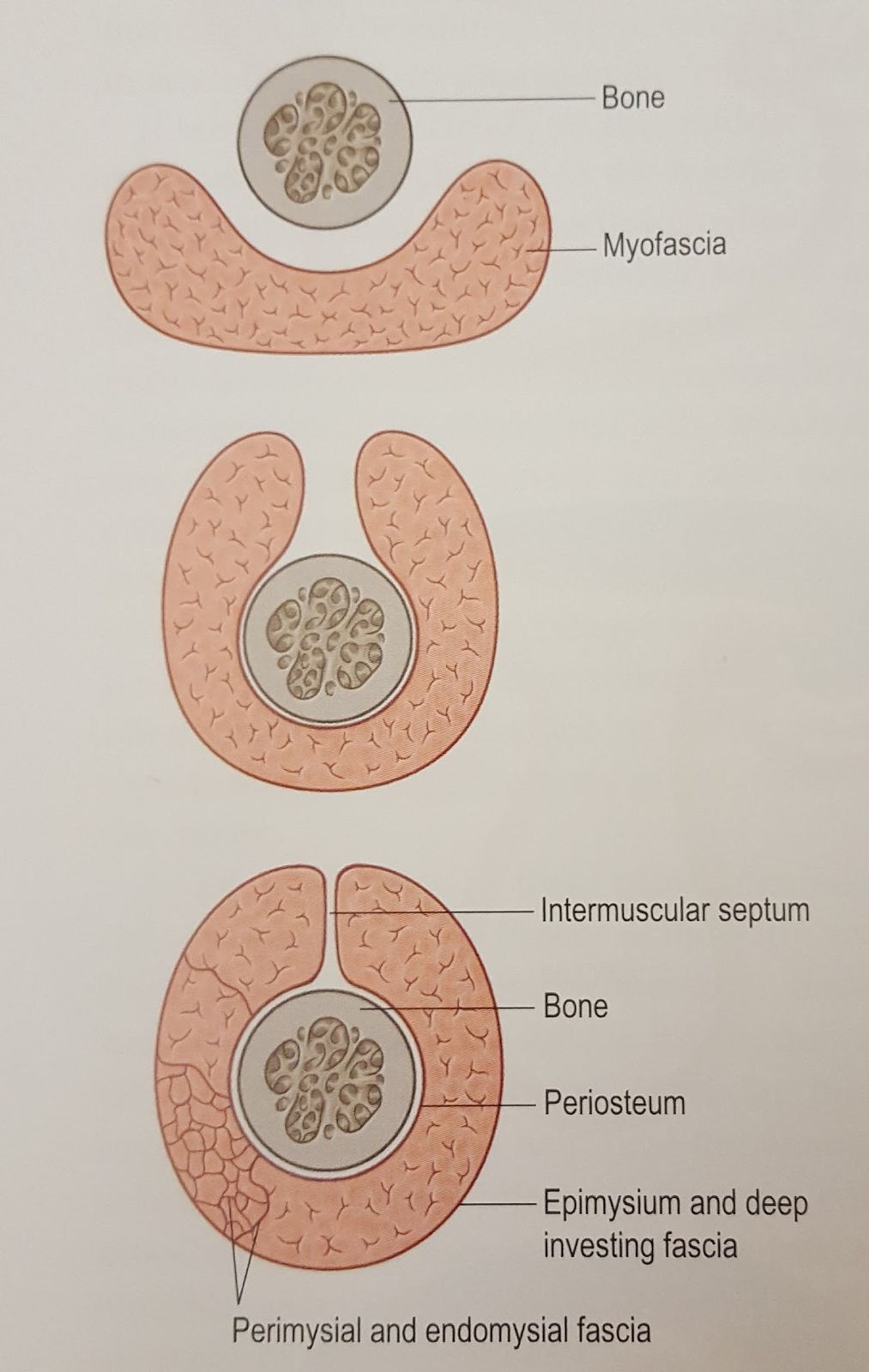
In movement, the muscle acts on the connective tissue (the bags) which in turns pulls on the bone. The action is much like a guy wire. The action of the fascia in a specific location is then generalized, or transmits movement, to a larger area. “Physical action alters the shape of the connective tissue bed throughout the structure, creating greater change where movement originates and rippling into more attenuated change farther away from the origin of movement” (The Endless Web, pg 33). So if the bicep acts on the humerus, the entire structure - scapula, clavicle, rib cage and so on - also moves.
This transmission of movement we often refer to as sliding. It can also be thought of as vibration or a wave traveling along the fascia train. How the fascial bags are organized, how vibration or sliding is transmitted from one station to the next, as well as the state of the fascia itself, determines the specifics of how movement is executed. Furthermore, these “interconnections are maintained with movement or inhibited with lack of movement” (The Endless Web, pg 4).
Movement, or “force transmission” as used by Thomas Myers in “Fascia” (Schleip, Findley, Chaitow and Huijing), can also be described as force being distributed via tensegrity to other parts of the body. Myofascial force distribution can create habitual neurological, muscular, and fascial patterns. Attempts to change muscle tone or neurological habit can be difficult without change in the fascial structure, or “fascial re-education.”
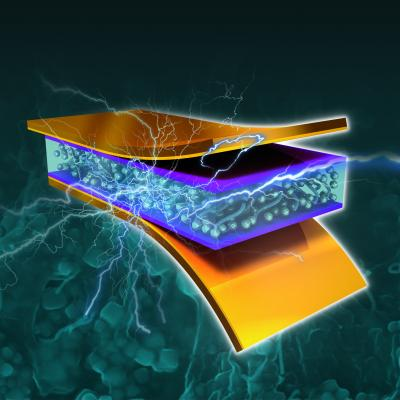
Fascia is also an electrical neural network (as opposed to the central and peripheral nervous system that is chemically based). More specifically, piezoelectricity is the electrical change generated by fascia in response to pressure and travels at the speed of sound. The electrical transmissions are faster than the chemically based neural signals. You have experienced this when you stepped on that sharp object and reflexively pulled your foot away from it before your conscious brain registered the sharp object poking you. Go ahead, thank your fascia for not allowing you to impale yourself.
On the other hand, “the speed at which fibers communicate compensation around the structural body is much slower” (Anatomy Trains, pg. 32). Motor patterns governed by the nervous system over time cause a change in the fascial system. It adapts to accommodate this pattern and becomes a “habit of movement, a set of fascial fibers, and a set of chemical pathways in the fluid.” This potentially can also create what we know as fascial adhesions (compacted fibers with ground substance in a glue-like state) or less-than-perfect motor patterns.
Fascia is described as “fuzz” Dr. Gill Hedley. In his YouTube video “The Fuzz Speech”, he demonstrates how fascia becomes rigid when we sleep and is liquified by movement. Fuzz assists the stabilization of the body to avoid compression of joints, blood vessels, lymphatic tissue and nerves during sleep. While that may be great when you’re napping, fascia in its liquid/gel form is more conducive to movement.
Remember your last shift? When you are experiencing achiness in your body, everything from the dull and annoying to the intense and all consuming constant sharp, this is most likely coming from your fascia. Fascia has a higher density of sensory receptors than muscle. These receptors include nocioreceptors (pain), mechanoreceptors (change in pressure and vibration), chemoreceptors (change in chemical make-up) and thermoreceptors (changes in temperature). When you are experiencing a novel change in motor pattern, sensory receptors in the fascia are stimulated. In turn, they relay a message to your brain alerting you to this change and to map the area. This message, as interpreted by our cognitive brain, is often labeled as achiness.
A few more points of interest:
Fascia is responsive to temperature. It is fluid in warmer temps and thicker or more viscous in cooler temperatures. Movement increases circulation and brings heat to the area where movement is occurring. Holding patterns on the other hand can decrease capillary circulation and the fascia changes from fluid to glue-like or ridged. This explains why many of our human snowbirds traveling south for the winter.
Some interesting videos about tensegrity:
Fat, flabbiness and “gristle” - “an excessive response of a body that is not in alignment or surface to deep tissue imbalance” - according to “The Endless Web.” So maybe change your motor patterns instead of dieting?
Onwards, Amy
Amy Bonaduce-Gardner | JUL 31, 2026
Share this blog post